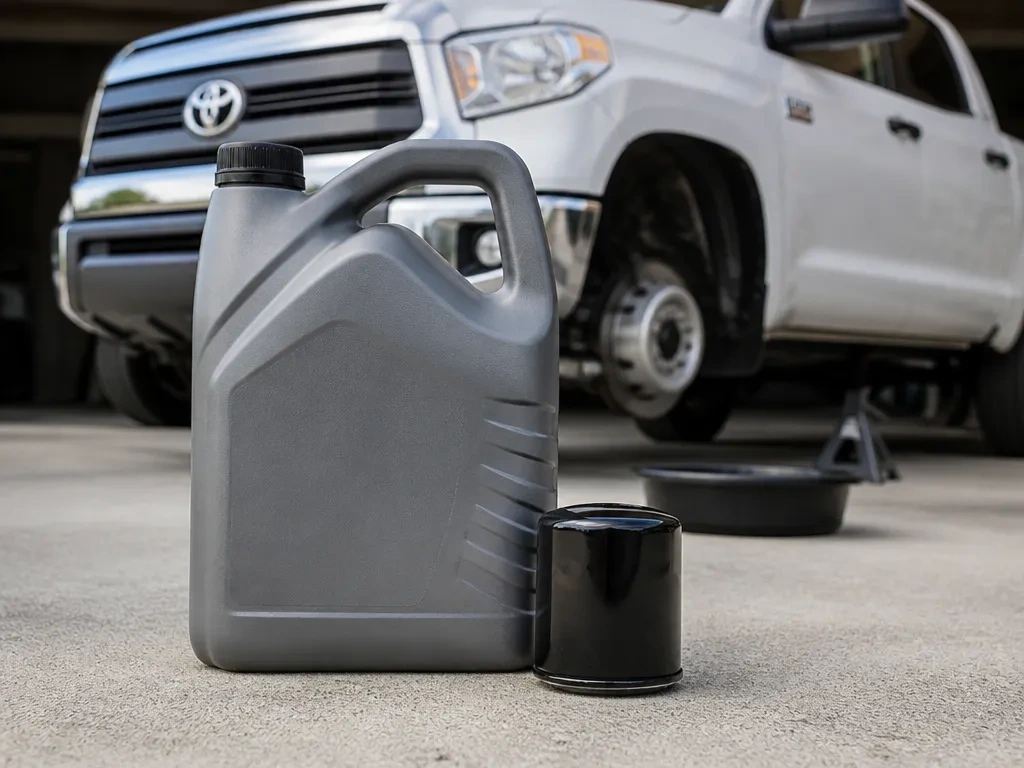
For a 2018 Toyota Tundra 5.7L V8, verify the exact engine-oil capacity in the Owner’s Manual or service information before filling. The figure must distinguish between an oil change with a new filter and a drain with the existing filter left installed.
Do not treat a published capacity as a substitute for the dipstick. Add less than the stated with-filter capacity initially, run the engine only as directed by the service procedure, allow the oil to settle, and adjust the level on level ground.
How Much Oil Does A 2018 Tundra 5.7l Take (With Filter)?
The exact with-filter capacity for a 2018 Toyota Tundra 5.7L V8 should be confirmed in the Owner’s Manual or Toyota service information for the truck’s VIN. Use the stated capacity as an initial fill reference, not as permission to pour in the entire amount without checking the dipstick.
Use the same conditions each time: level ground, the engine off, and the settling interval specified in Toyota’s procedure. A dipstick reading taken immediately after shutdown may not represent the final level.

What’s The Oil Capacity Without The Filter Installed?
A drain with the existing filter left installed will remove less oil than a service that also replaces the filter. The exact without-filter capacity should be verified in Toyota documentation for this engine and service configuration. Do not rely on an unverified conversion between quarts and liters.
“Without the filter” in practice means draining the oil while leaving the installed filter in place. The amount removed can vary with the drain procedure, settling time, and oil remaining in the engine. Use the dipstick rather than attempting to restore an unverified volume exactly.
| With filter | Without filter | |
|---|---|---|
| Capacity (qt) | Verify in Toyota documentation | Verify in Toyota documentation |
| Capacity (L) | Verify in Toyota documentation | Verify in Toyota documentation |
The difference between the two service conditions is the oil retained in the filter, housing, and engine passages. A partial drain is therefore not a reliable way to determine the exact quantity required for a complete oil change.
If the filter remains full of oil, adding the complete with-filter capacity after a partial drain may raise the level above the marked range. Add gradually and confirm the level before driving.
Why The Capacity Changes When You Replace The Oil Filter
The two service figures differ because oil remains in the filter and parts of the lubrication system after draining. Replacing the filter changes how much oil the engine can hold before the dipstick reaches its intended range.
Practical takeaway: Do not pour an unverified full capacity into an engine after an incomplete drain. Add a conservative amount first, allow the oil to settle as directed, and adjust to the dipstick range.
Toyota’s Recommended Oil Type And Viscosity For This Engine
The correct oil grade and performance specification must be taken from the 2018 Tundra Owner’s Manual or Toyota service information. The applicable choice can depend on the temperature guidance and documentation for the vehicle.
Viscosity Grade Toyota Specifies (Temperature-based)
Use the viscosity grade shown in Toyota’s temperature chart for the conditions in which the truck operates. Do not select a grade from a generic Tundra listing if the Owner’s Manual for the vehicle gives different guidance.
Oil Specification Toyota Requires (Api/ilsac Category)
Check the required oil performance category in the Owner’s Manual and confirm that the container label carries the stated specification. Viscosity alone does not establish that the oil meets Toyota’s requirement.
When shopping, confirm both the viscosity grade and the performance designation. If the label does not clearly match the required specification, verify the product before using it.
Where to verify in Toyota documentation: Check the “Recommended oil” section in the 2018 Tundra Owner’s Manual and confirm the same information in Toyota’s service documentation for the engine.
Which Oem Oil Filter Fits The 2018 5.7l Tundra
Verify the correct oil-filter part number for the truck’s VIN before buying a filter. Model-year listings and superseded part numbers can vary, so a generic application listing is not enough to establish fit.
OEM filter for the 2018 Tundra 5.7L V8: Confirm the current Toyota part number through the VIN, the vehicle’s maintenance documentation, or a Toyota parts source. Do not treat a part number in a general listing as definitive.
Aftermarket equivalent criteria (what must match):
Compatibility notes for trims and variations: Toyota part numbers can be superseded or vary by application. Use the VIN and the filter manufacturer’s fitment information together. A filter that matches only the thread may still have an incorrect gasket or body size.
If you cannot confirm the OEM number for your VIN, do not rely on a listing that only says it fits a Tundra. Verify the complete application and sealing dimensions before installation.
How To Verify The Correct Oil Level After Filling
The dipstick is the final check. A capacity figure is only an initial reference because the amount drained and the oil retained in the filter and engine can vary.
Common Pitfalls And Year-model Edge Cases For 2018 Tundra Oil Service
Oil service problems usually result from an incorrect oil specification, an incomplete drain, a damaged seal, or failure to verify the dipstick. Use the documentation for the exact truck rather than assuming that every 2018 Tundra listing is identical.
| Failure mode | What you’ll see | Main risk | Fix before driving |
|---|---|---|---|
| Wrong viscosity or wrong oil spec | The oil label does not match the Owner’s Manual requirements | The engine may not receive the specified lubrication | Verify the required grade and performance specification, then correct the fill if necessary |
| Overfilling | The dipstick is above the upper mark | Excess oil can create operating problems | Remove oil until the level is within the marked range |
| Underfilling | The dipstick is below the marked range | The engine may operate with insufficient oil | Add oil gradually and recheck under the correct conditions |
| Stuck filter gasket or double-gasket | Oil leaks around the filter mounting face | Oil loss and possible loss of lubrication | Remove the old gasket, clean the seat, and install the filter correctly |
| Drain plug thread damage | The plug will not start or tighten correctly | A continuing oil leak | Stop and repair the plug or threads rather than forcing the fastener |
| Climate edge cases and consumption | The oil grade does not match the documented temperature guidance, or the level falls between checks | Improper lubrication or delayed detection of a problem | Use Toyota’s documented grade and monitor the level |
The main checks are straightforward: confirm the oil grade and specification, verify the dipstick, and inspect the drain plug and filter seal. If the truck has an unusual filter listing or oil chart entry, follow the documentation tied to its VIN.
Practical Red Flags After The First Drive
Inspect the filter seam and drain area after the first drive. If you see a leak or the dipstick level falls unexpectedly, stop and correct the problem before continuing to drive.
Read Your Oil Consumption Trend, Not One Measurement
If the dipstick level falls between services, record the change and have the cause checked if the loss continues or appears unusual for the vehicle’s use.
Quick Summary
For a 2018 Toyota Tundra 5.7L V8, verify the exact with-filter and without-filter capacities in Toyota documentation for the truck. The two figures are not interchangeable, and the dipstick remains the final authority after filling.
Next action: Confirm the applicable capacities and specifications, add a conservative initial amount, then verify the dipstick and inspect for leaks before driving.
Frequently Asked Questions
How Much Does A Typical 2018 Tundra Oil Change Cost?
The price depends on local labor, the oil specification, and whether the filter and other sealing hardware are OEM or aftermarket. Ask for the oil grade, filter part number, and labor details before approving the work.
If a quote lists only a generic oil-change service, ask which oil specification and filter application it includes.
What’s The Right Schedule, And What Happens If I Go Past It?
Follow the interval stated in the 2018 Tundra Owner’s Manual for the vehicle and its operating conditions. If the truck is used under conditions Toyota classifies as severe, follow the corresponding guidance rather than a generic interval.
Checking the dipstick can reveal a low level, but it does not replace the required oil-change schedule.
Do I Need To Change The Oil More Often If I Tow Or Drive Mostly Short Trips?
Use Toyota’s severe-service guidance if towing, short trips, or other demanding conditions apply to your truck. The Owner’s Manual should determine whether the interval changes.
Monitor the dipstick between services. A recurring drop in level should be investigated rather than handled only by repeated top-offs.
What If The Shop Or Diyer Adds The “With Filter” Amount, But The Dipstick Still Reads Low?
Recheck the measurement on level ground after the oil has settled, with the engine off and the dipstick fully reinserted before reading it. If the level remains low, inspect for leaks and confirm that the filter and drain plug were installed correctly.
Do not keep driving if the level remains outside the marked range or if oil is leaking.
When Should I Stop And Get Professional Help Instead Of Trying Again Myself?
Get help if oil is actively leaking, the drain plug is damaged, the filter will not seal, or the oil grade or specification is uncertain.
Professional inspection is also appropriate if you cannot obtain a consistent dipstick reading after following the documented measurement procedure.
How Can I Verify The Shop’s Claim That They Used The Correct Oil And Filter?
Ask for the oil viscosity, performance specification, and filter part number shown on the work order or product packaging. Compare those details with the Owner’s Manual or Toyota parts information for your VIN.
If the receipt does not identify the oil and filter, request those details before considering the service complete.